Salicylaldehyde
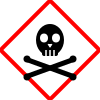 Skull and Crossbones
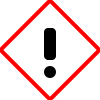 Exclamation Mark
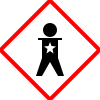 Health Hazard
Safety Data Sheets
| Manufacturer | Download |
|---|---|
| Combi-Blocks | Download PDF |
| Matrix Scientific | Download PDF |
Recommended safety equipment
Personal protective equipment commonly recommended for the hazard classes shown above.
Apron
Disposable Coveralls
View on Amazon →
Eyewash
Portable Eyewash Station
View on Amazon →
Gloves
Nitrile Disposable Gloves
View on Amazon →
Goggles
Safety Glasses
View on Amazon →
Goggles
Safety Goggles
View on Amazon →
Labels
GHS Secondary-Container Labels
View on Amazon →
Respirator
Half-Mask Respirator
View on Amazon →
Spill Kit
Chemical Spill Kit
View on Amazon →
As an Amazon Associate, DigitalMSDS earns from qualifying purchases.
Hazard Statements
| Code | Statement | Hazard Class |
|---|---|---|
H227 |
Combustible liquid | Flammable liquids |
H302 |
Harmful if swallowed | Acute toxicity, oral |
H311 |
Toxic in contact with skin | Acute toxicity, dermal |
H361 |
Suspected of damaging fertility or the unborn child | Reproductive toxicity |
H371 |
May cause damage to organs | Specific target organ toxicity, single exposure |
H401 |
Toxic to aquatic life | Hazardous to the aquatic environment, acute hazard |
H412 |
Harmful to aquatic life with long lasting effects | Hazardous to the aquatic environment, long-term hazard |
Precautionary Statements
| Code | Statement |
|---|---|
P203 |
Obtain, read and follow all safety instructions before use. |
P210 |
Keep away from heat, hot surface, sparks, open flames and other ignition sources. No smoking. |
P260 |
Do not breathe dust/fume/gas/mist/vapors/spray. |
P262 |
Do not get in eyes, on skin, or on clothing. |
P264 |
Wash hands [and ...] thoroughly after handling. |
P270 |
Do not eat, drink or smoke when using this product. |
P273 |
Avoid release to the environment. |
P280 |
Wear protective gloves/protective clothing/eye protection/face protection/hearing protection/... |
P301+P317 |
IF SWALLOWED: Get medical help. |
P302+P352 |
IF ON SKIN: wash with plenty of water/... |
P308+P316 |
IF exposed or concerned: Get emergency medical help immediately. |
P316 |
Get emergency medical help immediately. |
P318 |
if exposed or concerned, get medical advice. |
P321 |
Specific treatment (see information on this label and safety datasheet)). |
P330 |
Rinse mouth. |
P361+P364 |
Take off immediately all contaminated clothing and wash it before reuse. |
P370+P378 |
In case of fire: Use ... to extinguish. |
P403 |
Store in a well-ventilated place. |
P405 |
Store locked up. |
P501 |
Dispose of contents/container to ... |
Data Sources
- GHS Classification: PubChem CID 6998
Disclaimer: This information is compiled from public regulatory databases for reference only. It does not replace the manufacturer's Safety Data Sheet (SDS). Always consult the official SDS for your specific product before handling chemicals.
See something wrong? Report a data issue.