1,1,2,2-Tetrachloro-1,2-difluoroethane; CFC-112; R112
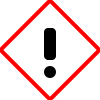 Exclamation Mark
Recommended safety equipment
Personal protective equipment commonly recommended for the hazard classes shown above.
Eyewash
Portable Eyewash Station
View on Amazon →
Gloves
Nitrile Disposable Gloves
View on Amazon →
Goggles
Safety Glasses
View on Amazon →
Labels
GHS Secondary-Container Labels
View on Amazon →
Spill Kit
Chemical Spill Kit
View on Amazon →
As an Amazon Associate, DigitalMSDS earns from qualifying purchases.
Hazard Statements
| Code | Statement | Hazard Class |
|---|---|---|
H332 |
Harmful if inhaled | Acute toxicity, inhalation |
H335 |
May cause respiratory irritation | Specific target organ toxicity, single exposure; Respiratory tract irritation |
H336 |
May cause drowsiness or dizziness | Specific target organ toxicity, single exposure; Narcotic effects |
H420 |
Harms public health and the environment by destroying ozone in the upper atmosphere | Hazardous to the ozone layer |
Precautionary Statements
| Code | Statement |
|---|---|
P261 |
Avoid breathing dust/fume/gas/mist/vapors/spray. |
P271 |
Use only outdoors or in a well-ventilated area. |
P304+P340 |
IF INHALED: Remove person to fresh air and keep comfortable for breathing. |
P317 |
Get emergency medical help. |
P319 |
Get medical help if you feel unwell. |
P403+P233 |
Store in a well-ventilated place. Keep container tightly closed. |
P405 |
Store locked up. |
P501 |
Dispose of contents/container to ... |
P502 |
Refer to manufacturer or supplier for information on recovery or recycling |
Exposure Limits
| OSHA PEL | 500 ppm |
| NIOSH REL | 500 ppm |
| NIOSH IDLH | 2000 ppm |
| Skin Notation | Yes — can be absorbed through skin |
Physical Properties
Colorless solid or liquid (above 77°F) with a slight, ether-like odor.
| Boiling Point | 199°F |
| Vapor Pressure | 40 mmHg |
| Specific Gravity | 1.65 |
Target Organs
narcosis, skin and eye irritation; difficulty in breathing
Synonyms
Refrigerant 112; Halocarbon 112; 1,2-difluoro-1,1,2,2-tetrachloroethane; Freon112
Data Sources
- GHS Classification: PubChem CID 6427
- OSHA PEL: OSHA Occupational Chemical Database
- NIOSH REL/IDLH: NIOSH Pocket Guide
Disclaimer: This information is compiled from public regulatory databases for reference only. It does not replace the manufacturer's Safety Data Sheet (SDS). Always consult the official SDS for your specific product before handling chemicals.
See something wrong? Report a data issue.